Nitrogen plays a critical role in modern manufacturing, food packaging, electronics production, and countless other industrial processes. As demand for high-purity nitrogen continues to rise, more companies are turning to on-site nitrogen generators as a safer, more cost-effective, and more reliable alternative to traditional nitrogen cylinders or bulk liquid supply. But what exactly is a nitrogen generator, and how does it transform ordinary compressed air into a continuous stream of high-purity nitrogen?
In this guide, we’ll explain what a nitrogen generator is, the science behind how it works, and why businesses across industries—from food and beverage to SMT electronics and laser cutting—are switching to on-demand nitrogen production. Whether you are researching new equipment, upgrading your plant, or simply curious about the technology, this article will give you a clear, practical understanding of nitrogen generators and their benefits.
Cataloge
- What’s Nitrogen
- What’s the Application of nitrogen in Industry?
- How is Industrial Nitrogen Produced?
- What’s nitrogen generator
- Why need nitrogen generator
- How does nitrogen generator work?
- What type of nitrogen generator?
- Conclusion
What’s Nitrogen?
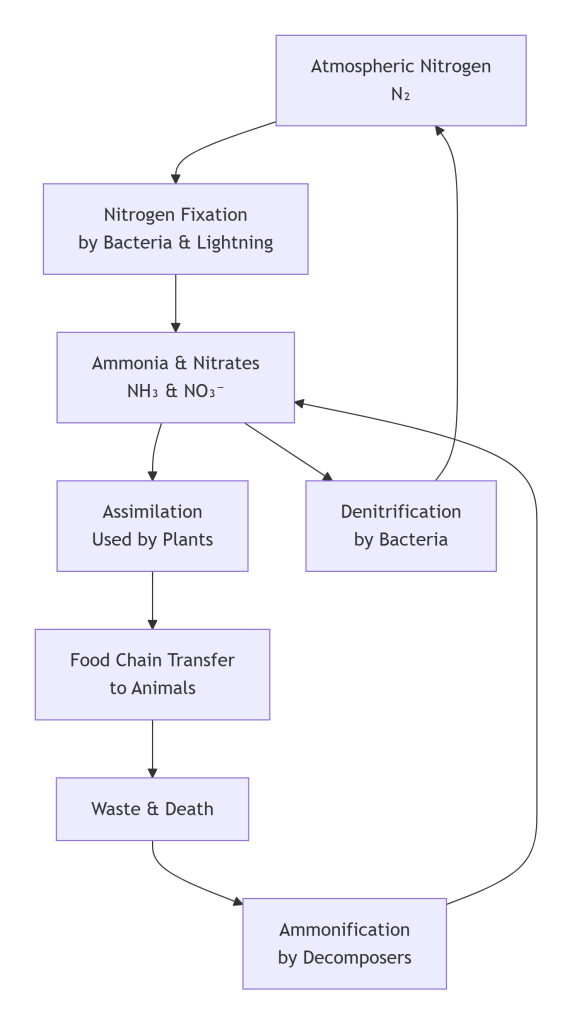
Nitrogen is a chemical element with the symbol N and atomic number 7. Nitrogen gas (N₂) is one of the most abundant gases in nature, making up 78% of the Earth’s atmosphere. It is a colorless, odorless, tasteless, and non-toxic inert gas. Under standard conditions, nitrogen gas has a density of 1.2506 kg/m³, slightly lighter than air. The nitrogen molecule has a simple structure, consisting of two nitrogen atoms bonded by a triple bond, exhibiting high stability and low reactivity.
What’s the Application of nitrogen in Industry?
1. Food and Beverage Industry
In this sector, nitrogen is all about preservation and protection.
Modified Atmosphere Packaging (MAP): Air (which contains oxygen) is removed from food packaging and replaced with pure nitrogen (or a nitrogen-rich mix). This:
Prevents oxidation, which causes spoilage (e.g., rancidity in oils and chips).
Stops the growth of aerobic bacteria and fungi.
Protects the physical shape of fragile items (like potato chips) by acting as a cushioning “pillow pack.”
2. Electronics and Semiconductor Manufacturing
This is a high-purity, critical application.
Inerting during Production: The production of semiconductors, transistors, and circuit boards is extremely sensitive to oxygen and moisture. Nitrogen is used to create an ultra-pure inert atmosphere in furnaces and soldering ovens to prevent oxidation during the manufacturing process.
Purging: Nitrogen is used to purge or clean out pipelines and chambers of reactive gases before and after chemical processes.
3. Chemical and Petrochemical Industry
Here, nitrogen is a vital tool for safety.
Purging and Inerting: Nitrogen is used to purge tanks, reactors, and pipelines of flammable or toxic vapors before maintenance or a change in product. This prevents the formation of explosive mixtures.
Blanketing: Storage tanks containing volatile or flammable chemicals (like gasoline, solvents, and crude oil) are kept under a nitrogen “blanket.” This inert layer on top of the liquid prevents fire and explosion by keeping oxygen out.
Pressure Transfer: Nitrogen is used to safely push (“pneumatically transfer”) fluids and powders through pipes without the risk of combustion.
4. Metalworking and Heat Treatment
Nitrogen protects metals from reacting at high temperatures.
Annealing and Sintering: Used in furnaces during the heat treatment of metals to prevent scaling and oxidation (rust) on the surface of the finished product.
Laser and Plasma Cutting: Used as an assist gas to blow molten material away from the cut, resulting in a clean, oxide-free edge, especially on non-ferrous metals like aluminum and stainless steel.
5. Pharmaceuticals and Healthcare
Blanketing: Similar to the chemical industry, nitrogen blankets protect sensitive and volatile chemical compounds during drug manufacturing and storage.
Purging: Used to ensure the sterility and stability of products by removing oxygen from packaging and containers (e.g., vials and ampoules).
Liquid Nitrogen in Medicine:
Cryopreservation: Used to freeze and preserve biological samples like blood, sperm, eggs, and tissues for long periods.
Cryosurgery: Used to destroy abnormal or diseased tissue (like warts, pre-cancerous cells, and skin tags) by freezing it.
6. Oil and Gas Industry
Enhanced Oil Recovery (EOR): High-pressure nitrogen is injected into oil reservoirs to maintain pressure and push out more crude oil that would otherwise be left behind.
Well Workovers and Completions: Used to purge flammable gases from wells and pipelines to ensure safe conditions for workers.
7. Tire Inflation
“Nitrogen Fill” for Tires: Using nitrogen (which is drier than air) minimizes pressure changes due to temperature fluctuations, reduces rim corrosion (because no oxygen or moisture is present), and can slightly improve fuel efficiency. This is common in aircraft, race cars, and heavy-duty mining vehicles.
How is Industrial Nitrogen Produced?
Industries get nitrogen in two primary ways: Cryogenic Distillation: The most common method for large-scale production. Air is cooled to very low temperatures until it liquefies. Since nitrogen, oxygen, and argon have different boiling points, they are then separated by distillation in a tall column. This produces high-purity, bulk liquid nitrogen. Pressure Swing Adsorption (PSA) / Membrane Systems: These are “on-site” or “on-demand” generators. They force compressed air through a system (either a vessel with a carbon molecular sieve or a hollow-fiber membrane) that selectively separates nitrogen molecules from oxygen and other gases. This is cost-effective for facilities with a constant, mid-level demand.
Why need nitrogen generator in industry?
In short, an on-site nitrogen generator provides a reliable, cost-effective, and safe supply of high-purity nitrogen, tailored to an industry’s specific needs. It eliminates the dependency and logistical challenges of delivered nitrogen.
Here’s a detailed breakdown of why industries need nitrogen generators:
1. Massive Cost Reduction
This is often the primary driver. Relying on delivered nitrogen comes with significant, recurring expenses:
2. Unmatched Supply Reliability and On-Demand Production
No More Supply Chain Risks: You are immune to delivery delays caused by weather, truck breakdowns, driver shortages, or logistical problems. Your production never has to stop because the nitrogen truck is late.
3. Enhanced Safety
Elimination of Handling Risks: Delivered nitrogen involves handling heavy high-pressure cylinders or cryogenic liquid.
4. Superior Purity Control and Consistency
Tailored Purity: Different applications require different nitrogen purities. A generator can be precisely tuned to deliver the exact purity level needed—whether it’s 95% for tire inflation or 99.999% for electronics manufacturing.
5. Environmental Benefits
Reduced Carbon Footprint: Eliminating the constant need for diesel trucks to deliver nitrogen significantly reduces the associated CO₂ emissions.
Summary: Delivered Gas vs. On-Site Generator
| Feature | Delivered Nitrogen (Cylinders/Liquid) | On-Site Nitrogen Generator |
| Cost | High recurring cost (gas, rental, delivery). | High initial cost, very low operating cost. |
| Supply | Finite, risk of running out. Dependent on deliveries. | Infinite, on-demand. Independent. |
| Purity | Fixed, usually high. Potential for batch variation. | Adjustable and perfectly consistent. |
| Safety | Risks from handling cryogenic liquids & high-pressure cylinders. | Reduced risk; no handling of delivered gas. |
| Footprint | Requires space for tanks/cylinders and delivery access. | Compact, fixed installation. |
| Environment | High emissions from transportation and liquefaction. | Lower overall carbon footprint. |
How does a nitrogen generator work?
A nitrogen generator works by separating nitrogen gas (N₂) from the other components in ordinary air, primarily oxygen (O₂).
Since air is about 78% nitrogen and 21% oxygen, the goal is to remove the oxygen, water vapor, and other trace gases to leave behind pure nitrogen.
There are two main technologies used in industrial nitrogen generators, both of which start with the same first step:
Common First Step: Air Preparation
A compressor draws in ambient air and compresses it.
The compressed air is then cooled and passed through a series of filters to remove water vapor, oil aerosols, and other particulates. This clean, dry, compressed air is then fed to the core separation technology.
What type of nitrogen generator?
When we talk about “types” of nitrogen generators, we are primarily distinguishing between the two core technologies used for separation: Pressure Swing Adsorption (PSA) and Membrane Separation.
However, they can also be categorized by other factors like their intended output. Here’s a clear breakdown of the types.
A. Pressure Swing Adsorption (PSA) Nitrogen Generators
As explained previously, it uses a Carbon Molecular Sieve (CMS) to adsorb oxygen and other gases from compressed air under pressure, allowing nitrogen to pass through. Two towers alternate between adsorption and regeneration to provide a continuous flow.
B. Membrane Nitrogen Generators
Uses a bundle of hollow-fiber membranes. Gases like oxygen and water vapor permeate through the membrane walls faster than nitrogen, which travels through the center and is collected as the product gas.
In summary:
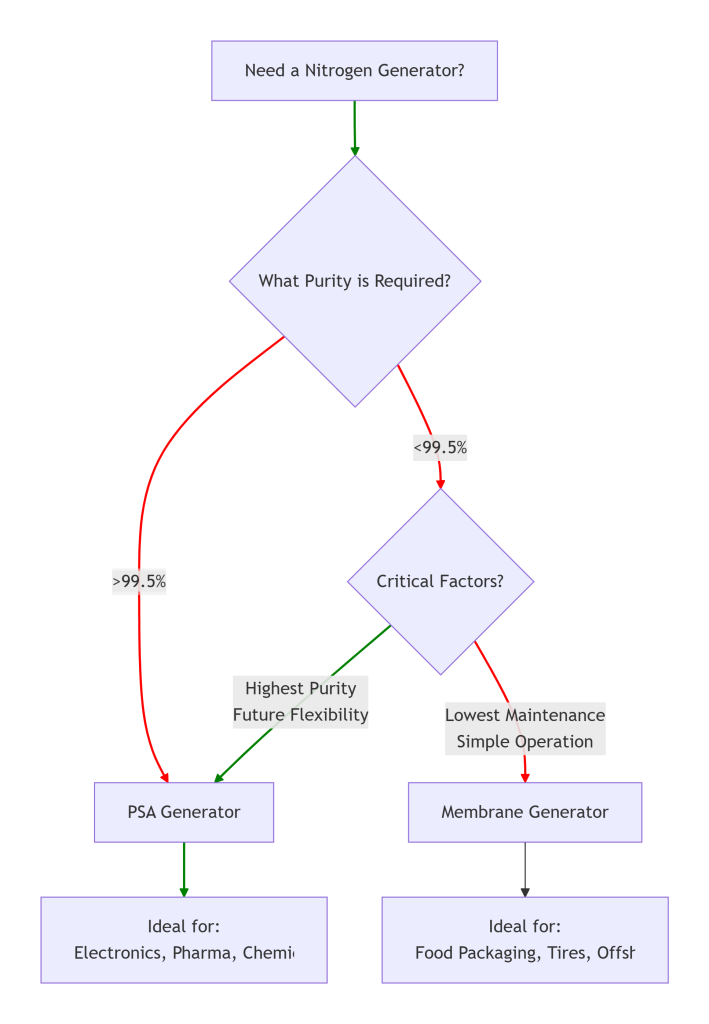
For high purity (above 99.5%), a PSA Generator is the undisputed choice.
For standard purity (95-99.5%), the decision leans towards a Membrane Generator if your priorities are lowest maintenance and simplicity, and towards a PSA Generator if you need the highest possible purity within that range or think your purity requirements might increase in the future.
Conclusion:
Nitrogen is no longer just a consumable commodity to be purchased and delivered. With the advent of reliable Pressure Swing Adsorption (PSA) and Membrane Separation technologies, it has become a utility that can be generated on-demand, much like electricity or compressed air. This shift offers unparalleled control, efficiency, and independence.