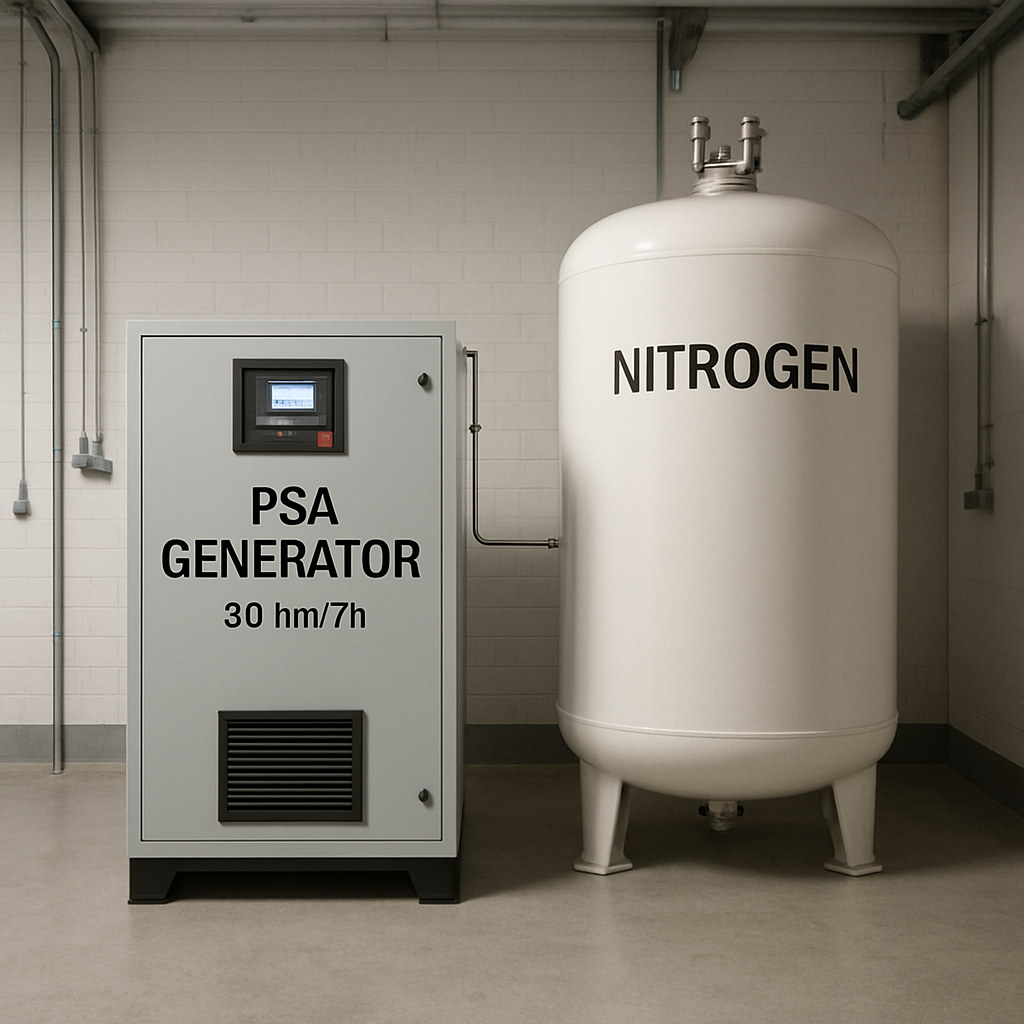
Every breath you take is 78% nitrogen, yet businesses spend fortunes waiting for heavy metal cylinders to arrive. Why pay a delivery truck to haul something already floating free in your facility? In practice, abandoning endless cylinder rentals allows owners to instantly transform a volatile monthly gas expense into a predictable fixed asset.
Harvesting this resource relies on a technology known as a PSA nitrogen generator. PSA stands for Pressure Swing Adsorption—a separation process acting like a microscopic bouncer that traps unwanted oxygen at the door while letting pure nitrogen pass through. Industry data reveals that producing your own gas on-site fundamentally improves uptime by eliminating the panic of running empty during a crucial shift.
Finding the ideal machine scale is where the 30 Nm3/h PSA nitrogen gas generator shines as the “Goldilocks” solution for light industrial shops. Operating at this versatile capacity unlocks the true benefits of onsite nitrogen production, granting small-to-medium facilities total independence from outside suppliers.
The Bouncer Analogy: How PSA Technology Filters Nitrogen from Thin Air
Everyday air is a mixture of gases; the trick is isolating the nitrogen. The Carbon Molecular Sieve (CMS) inside a PSA nitrogen generator functions as a strict nightclub bouncer. When pressurized air rushes in, this CMS stops oxygen molecules at the door while letting the nitrogen flow straight through. This surface-level trapping is called adsorption. Unlike a sponge soaking up water (absorption), the oxygen merely sticks to the outside of the material. Because this separation tower relies on physics rather than moving parts, mechanical failure is exceedingly rare.
A reliable four-stage cycle keeps pure product flowing continuously:
- Compression: Standard air gets pushed into the first tank under high pressure.
- Adsorption: The CMS traps the unwanted oxygen on its surface.
- Desorption: The tank depressurizes, venting the trapped oxygen back into the room—clearing out the stopped molecules.
- Equalization: Pressure balances between two paired tanks, preparing the second to take over seamlessly.
Over years of constant filtering, this sieve material eventually loses its grip. When that happens, the carbon molecular sieve replacement process is straightforward, restoring the system to peak efficiency without requiring a whole new machine.
Visualizing 30 Nm3/h: Is This Capacity Right for Your Shop?
Staring at an equipment spec sheet, “30 Normal Cubic Meters per Hour” sounds incredibly abstract. To picture this physical volume, imagine a machine filling 500 standard party balloons every single hour, non-stop. When choosing the right nitrogen generator capacity, success comes down to managing your peak demand—the absolute maximum amount of gas your shop needs at its busiest moment. This specific size provides excellent flow rate scaling, ensuring a steady, reliable supply during heavy shifts without ever falling back on expensive reserve cylinders.
Evaluating current nitrogen gas procurement costs quickly reveals if this volume makes financial sense for your facility. Generally, a 30 Nm3/h machine perfectly supports light industrial setups like:
- Single laser cutters slicing through light metals
- Medium food packaging lines extending snack freshness
- Electronics soldering stations requiring continuous, clean coverage
Eliminating heavy cylinder deliveries for these daily processes quickly pays for the equipment. With volume requirements established, selecting the appropriate separation method is the next critical step.
PSA vs. Membrane Generators: Choosing the Efficient Path
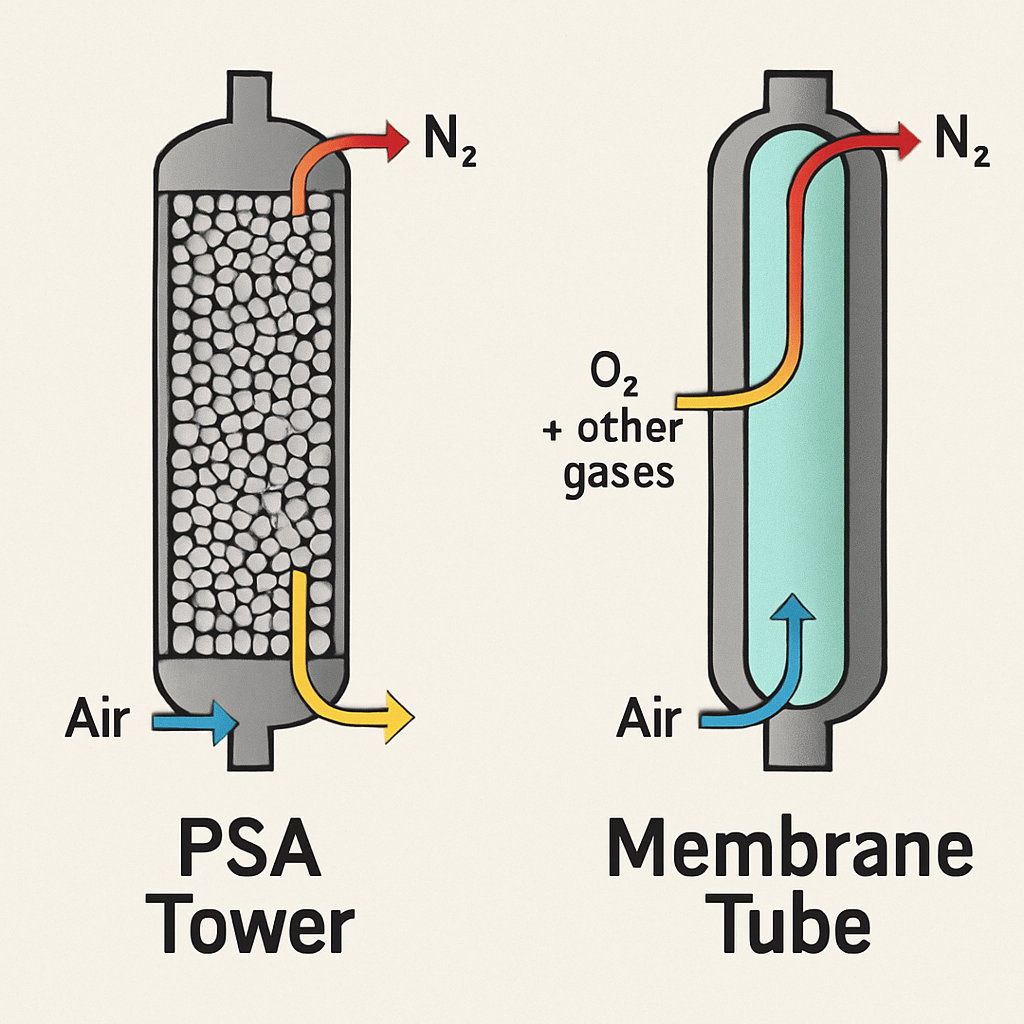
Making your own gas means choosing between two distinct separation methods. Membrane technology uses a process called permeation, pushing compressed air through bundles of microscopic tubes. Oxygen molecules slip out through the tube walls, while nitrogen travels straight to the end. It is simple, but it struggles to achieve the ultra-clean gas needed for sensitive work.
For tighter nitrogen purity levels—often requiring 99.9% or higher for industrial applications—Pressure Swing Adsorption (PSA) is the undeniable industry standard. Instead of porous tubes, a PSA system uses tanks filled with Carbon Molecular Sieve to trap unwanted oxygen, letting only pure nitrogen flow seamlessly into the facility.
Evaluating PSA vs. membrane nitrogen generators over a ten-year lifespan reveals a clear financial winner for a 30 Nm3/h setup. While membranes are cheaper upfront, PSA units offer vastly superior durability. Because the sieve material rarely degrades under proper maintenance, total long-term operating costs drop significantly. However, pushing raw air into these separation systems requires proper supporting hardware.
Powering the System: Air Compressor and Tank Requirements
Even the best PSA system requires an external push. Since a compressor provides the essential force to feed the machine, sizing it properly ensures the operation is never starved. The golden rule for air compressor requirements for nitrogen generation is the 4:1 ratio. To produce a target 30 Nm3/h of nitrogen, the compressor must intake roughly 120 Nm3/h of ambient air.
Pushing enough air is only half the battle; that air must also be perfectly clean. Feed air quality dictates the lifespan of the machine. If oil or water coats the sensitive Carbon Molecular Sieve, it loses its ability to filter oxygen. Therefore, a complete system requires essential support equipment:
- A refrigerated dryer to strip away rust-causing moisture
- Oil-mist filters to catch microscopic lubricants
- The 4:1 air-to-nitrogen ratio rule applied to compressor sizing
Once transformed, the pure nitrogen enters a receiver vessel for facility use on demand. Maintaining this system requires strict attention to nitrogen gas storage tank safety, meaning routine checks of pressure relief valves and proper structural anchoring. With the hardware properly configured, the focus shifts to dialing in exact gas specifications.
Purity Matters: Matching Nitrogen Quality to Your Application
Oxygen causes problems—it makes metal rust, food spoil, and fires burn through a process called oxidation. By replacing that oxygen with nitrogen, an “inert” or non-reactive environment is created where these costly issues stop. However, catching every single oxygen molecule takes time. With a generator, there is a strict tradeoff between gas purity and flow volume. Demanding ultra-pure nitrogen means the machine processes air much slower. Accepting a slightly lower purity yields more gas, faster, helping avoid overpaying for unnecessary precision.
Navigating nitrogen purity levels for industrial applications comes down to exactly what is being protected. For instance, nitrogen generation for food packaging requires vastly different settings than high-tech manufacturing. Consider these common targets:
- 95% Purity: Perfect for fire suppression, where simply lowering oxygen is enough to smother sparks.
- 99.5% Purity: The standard for food packaging, ideal for keeping snacks fresh and extending shelf life.
- 99.99% Purity: Necessary for precision laser cutting and electronics soldering, where trace oxygen causes microscopic defects.
Once the system is dialed in, keeping it running safely requires a simple, consistent approach.
The 5-Minute Maintenance Routine: Keeping the Gas Flowing
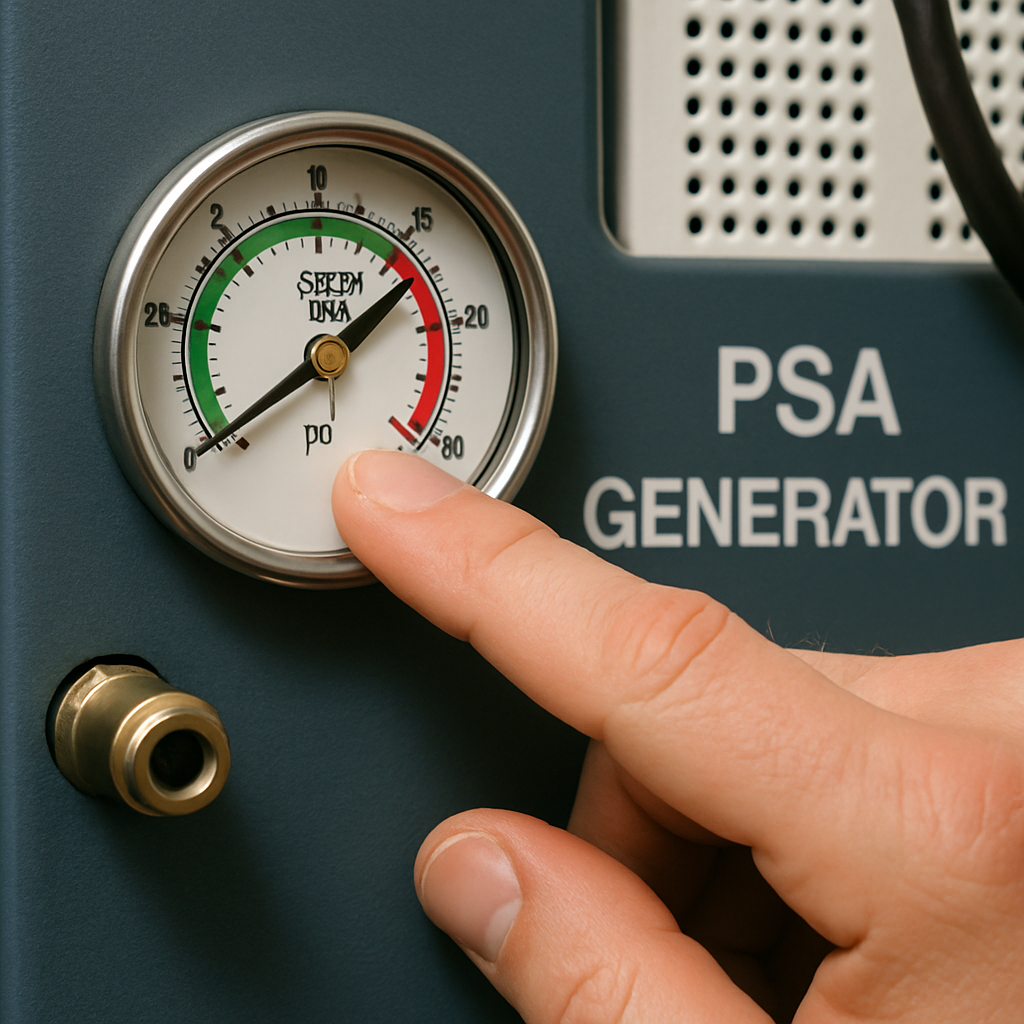
Protecting the machine doesn’t require an engineering degree. A practical PSA nitrogen generator maintenance guide emphasizes keeping the incoming air perfectly clean. If the pre-filters reach filter saturation—becoming completely soaked with oil or water—contaminants will slip past and permanently ruin the carbon molecular sieve (CMS). It is also vital to listen to the machine’s rhythmic hiss. This sound indicates pressure equalization, the brief moment the towers balance internal pressure before switching jobs. An inconsistent rhythm is the first warning sign of trouble.
- Weekly: Drain trapped moisture from all pre-filters.
- Monthly: Inspect valves and listen for consistent pressure equalization.
- Annual: Replace filter elements and verify baseline CMS performance.
Catching warning signs early is the secret to troubleshooting low nitrogen gas purity. If gas purity drops despite having brand-new filters, the CMS is likely failing and needs intervention before production completely stops. Fortunately, adhering to this basic air filter care routine easily extends a generator’s lifespan to 15+ years. Proper maintenance naturally leads to long-term reliability and an end to cylinder rentals.
Your Transition Plan: From Monthly Bills to Onsite Ownership
Generating your own supply represents more than just upgrading equipment; it is a definitive move toward operational independence. To begin reducing nitrogen gas procurement costs, conduct a 12-month gas spend audit to calculate potential return on investment.
Next, prepare the facility floor for a compact 30 Nm3/h installation by verifying available space and power supply. Finally, consult a sizing expert who can properly specify a nitrogen generator system tailored exactly to daily production volumes. Taking these practical steps ensures predictable cost stability and a reliable, continuous gas supply during the busiest production shifts.